NEURONwriter Review 2026
NEURONwriter promises to make content research and on-page optimization more structured. But is it worth paying for when you run a blog, an affiliate site, or a small WordPress business?
NEURONwriter is worth considering when you publish consistently and need structured SERP research and content editing. For a small site, however, its value depends on analysis limits, AI credits, and the exact features included in the plan you choose—not on promises of better rankings.
This review explains what the tool does, what our research process actually showed, the published costs, and when a simpler workflow might be enough.
Editorial disclosure: This article contains affiliate links. We may earn a commission if you purchase through them. Our recommendations remain independent.
Pricing checked: November 6, 2026. Plans, promotions and checkout terms may change.
Quick Verdict
Best for: Publishers who regularly research, write or refresh search-focused content and want a consistent process for comparing competing pages, planning an outline and checking topic coverage.
For standard subscriptions, consider Bronze first if you manage one or two projects and can transfer content into WordPress manually. Silver raises usage limits; Gold adds direct publishing and search-data connections plus advanced features. A separately advertised Bronze Lifetime offer has different feature terms, so do not compare it with the Bronze subscription by name alone.
Skip it for now if you rarely publish, have no validated content plan, or expect a content score to make a page rank. NEURONwriter is a workflow aid, not a replacement for original information or sound editorial choices.
What Is NEURONwriter?
NEURONwriter is an SEO tool for content research and optimization. It analyzes search results for a target keyword or query and presents information intended to help a writer understand competitors, plan topics and improve a draft. Its content editor suggests terms and heading concepts, while separate AI features can help with writing-related tasks.
For an independent publisher, the appealing part is not simply generating more words. It is having a repeatable set of questions: Which pages are we comparing? What do those pages cover? Which terms and reader questions matter? What can our own page add that is accurate and useful?
The tool is most relevant after you have decided what problem a reader needs solved. It cannot establish demand for a topic on its own, prove that every competing page is trustworthy, or verify product claims for you.
NEURONwriter Key Features
SERP and Competitor Analysis
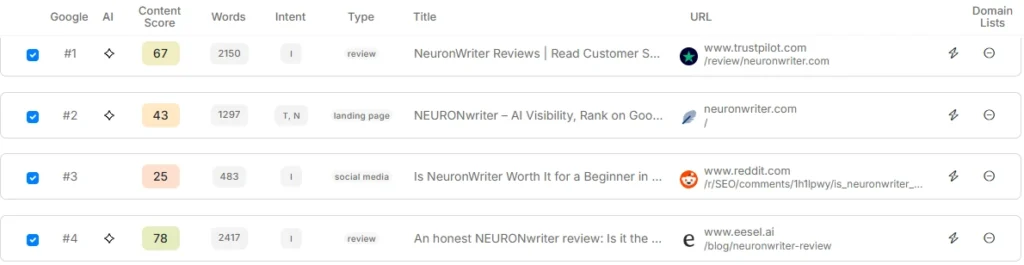
NEURONwriter offers competitor-selection views for a target query. That matters because the automatic top results can include material that does not match your planned article: a vendor homepage, a discussion thread, a video, or a customer review page may all appear alongside detailed editorial reviews.
Selecting only the competitors that share the intended search intent is more helpful than blindly accepting the first ten. The checkmarks in our initial-results screenshot reflect the tool’s default TOP10 selection, not our final editorial shortlist. A published page’s high Content Score is not proof of editorial accuracy or product quality.
For a practical walkthrough, see how to choose SERP competitors in NEURONwriter.
Content Editor and Content Score
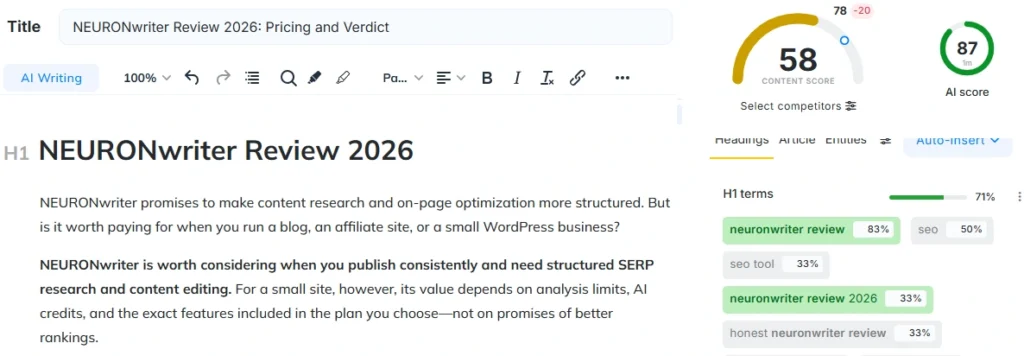
For content optimization, the editor displays NLP (natural language processing) terms, related concepts and heading suggestions drawn from the pages selected for analysis. Its Content Score summarizes aspects of content coverage against the tool’s recommendations; it is not a Google metric. It can flag an important concept you overlooked or a subject that deserves a clearer explanation.
It does not measure whether a claim is true, whether the recommendation is independent, or whether Google will rank the page. Google’s guidance emphasizes helpful, reliable, original content rather than satisfying the score of an external SEO product.
A practical rule: use the score to find possible omissions, then decide whether each suggested phrase belongs in the article. If adding a term makes the text less natural or less accurate, leave it out. Our own draft’s before-and-after example is described in the workflow section below.
AI Writing and Content Designer
NEURONwriter offers AI-assisted writing options, including templates and additional features on higher plans. Those tools can help structure or revise a draft, but their output still needs fact-checking and editing.
For standard subscriptions, Content Designer, advanced AI templates and plagiarism checks are listed for Gold and higher. Plagiarism checks have a separate plan allowance; a similarity report does not establish that every factual claim in a draft is correct. The separately advertised Lifetime plans may have different feature entitlements, so compare the exact offer instead of relying on the Bronze or Gold name alone. Official Plagiarism Checker FAQ.
WordPress and Google Search Console
For standard subscriptions, NEURONwriter’s official documentation lists direct WordPress and Google Search Console connections from Gold upward. The separate Bronze Lifetime offer also advertises these connections, so verify the exact purchase terms before assuming equivalent access. The publishing connection is intended to support importing and exporting content; the Search Console connection can bring search-performance data into the workflow.
If you use Bronze or Silver, you can still prepare content in the editor, move it into WordPress manually, and check Search Console separately. That is slower, but it may be adequate for a small publishing operation.
GSC clicks and impressions are not total site visitors, and connecting Search Console does not track affiliate sales.
Our NEURONwriter Workflow
For this guide, our editorial research materials included screenshots and suggested-term exports for two NEURONwriter queries: neuronwriter review and neuronwriter pricing. The screens showed different mixes of results. The review query included editorial reviews alongside a vendor page, community discussions and video results. The pricing query included pricing-oriented guides, comparison pages and lifetime-offer pages.
That difference illustrates why choosing competitors matters. A review has to answer whether the product is useful, while pricing research has to answer which commitment and plan make sense. Combining the two can create a better buying guide, provided the article still has one main purpose.
What We Observed in Our Own Draft
We worked with two queries—neuronwriter review and neuronwriter pricing—because they answered different reader questions. The first exposed a mix of independent reviews, product pages and community results; the second was more focused on plans, comparisons and lifetime offers. We checked relevance rather than accepting the default competitor selection as our finished research set.
In the neuronwriter review editor, our draft recorded Content Score 52. After targeted changes to headings and the natural use of terms such as keyword, SEO tool and content optimization, it recorded 58—a six-point improvement. The score was still below the editor’s displayed competitor reference of 78. The point of this test is not that 58 is a success threshold: it shows that the tool responds to editorial changes while leaving the harder questions of accuracy, originality and ranking for human judgment and real-world evidence.
We also reviewed the tool’s suggested-term exports. Some prompts were relevant, such as AI credits and content score; others included repetitive phrases or price fragments that needed verification. We refused to force every recommended frequency into the text, especially when suggestions risked repeating the same concept. This is an account of one editorial workflow, not a controlled test of search performance.
What we did not test: We did not independently benchmark the AI writer, connect a live WordPress site or GSC through NEURONwriter, measure ranking or traffic changes, test refund handling, or complete a Lifetime checkout. The screenshots document the steps we observed, not end-to-end product performance.
NEURONwriter Pricing Explained
NEURONwriter lists five standard subscription tiers. The following standard subscription prices and allowances were displayed on its official public pricing page when checked on November 6, 2026.
| Subscription | Pay monthly | Pay yearly | Projects | Monthly queries / analyses | Monthly AI credits |
|---|---|---|---|---|---|
| Bronze | $23/month | $230/year | 2 | 25 | 15,000 |
| Silver | $45/month | $450/year | 5 | 50 | 30,000 |
| Gold | $69/month | $690/year | 10 | 75 | 45,000 |
| Platinum | $93/month | $930/year | 25 | 100 | 60,000 |
| Diamond | $117/month | $1,170/year | 50 | 150 | 75,000 |
These are advertised USD prices before account-specific checkout details such as taxes or currency conversion. Annual payment means paying the yearly amount up front; it is not the same as committing to a lower monthly invoice. Check the live official pricing page before purchasing.
AI Credits and Content Analyses Are Different
This distinction matters more than the headline price. Content Writer analyses refer to research queries/analyses you can create within the plan’s allowance. NEURONwriter describes this as a renewable monthly limit, with each new query consuming an analysis.
AI credits are a different allowance used by features such as text generation, AI images, Auto Insert Terms and AI Optimization. Different actions may cost different amounts. Using AI credits does not, by itself, use up the separate Content Writer analysis quota.
The vendor says monthly analysis and AI-credit allocations renew and unused monthly allowances do not roll over. Check your account’s actual reset cycle rather than assuming a fixed calendar day. Separately purchased pay-as-you-go AI credits have different terms: the vendor says they can be used within 12 months of purchase, with the monthly allocation spent first. Confirm current eligibility and checkout details before relying on add-on credits.
This means a publisher may have sufficient AI credits left but lack another new analysis—or have analyses available without enough credits for a particular AI task. Compare both limits against your actual workflow before upgrading.
Lifetime Deals and Promotions
For readers considering a NEURONwriter lifetime deal, the vendor maintains a separate official Lifetime offer page that, on November 6, 2026, advertised Bronze at $179, Gold at $537, and Diamond at $895 as one-time purchases. The page labels the offer limited-time; the published figures do not, on their own, establish checkout availability for every buyer or how long the offer will remain open.
Do not confuse similarly named plans. The official Bronze Lifetime listing includes several features—including Content Designer and WordPress/GSC integrations—that the standard Bronze subscription does not list. The vendor also says lifetime-plan monthly analyses and AI credits reset each month, while the project limit is fixed. Confirm the precise plan agreement and checkout entitlements rather than assuming any legacy or subscription tier has identical features.
Which commitment makes more sense? A monthly Bronze subscription costs less up front and gives you a way to reassess your needs. Annual billing reduces the advertised total cost compared with 12 separate monthly payments but requires a larger commitment. A Lifetime purchase requires a one-time payment and may become attractive if you expect sustained use—but only if its actual checkout entitlements, ongoing service terms, refund conditions and restrictions match your needs. Lifetime describes a purchase offer; it is not a promise that every feature or service will remain unchanged indefinitely. Compare the precise offer, not just the plan name or the apparent break-even period.
Separately, affiliate-account screenshots used in our research displayed Black Week promotional creatives. We did not establish an active 50% checkout discount, its valid dates, stacking rules, or whether a specific affiliate link qualifies. This review therefore makes no promise of a Black Week discount. Compare the subscription pricing page, the official Lifetime page and the final checkout terms before choosing.
NEURONwriter Pros and Cons
What Works Well on Paper—and in the Research Views
- A structured research workflow: The two query examples showed how a writer can separate a broad product review from a specific plan/pricing investigation.
- Useful semantic prompts: Terms and headings can reveal overlooked subtopics without dictating the final outline.
- A smaller subscription entry point: Standard Bronze may cover modest research needs without paying for higher subscription tiers.
- An upgrade path: Higher tiers add capacity, and Gold unlocks documented integrations and advanced tools.
- A clear distinction between allowances: Official documentation separates content analyses from AI-credit use.
Limitations to Take Seriously
- No ranking guarantee: Content Score is an editing signal, not a Google result.
- Plan-gated features: Important integrations and tools are not on every tier.
- Separate quotas: Documents, projects and AI credits may become constraints at different times.
- Research still needs judgment: A competitor can be irrelevant, outdated, commercially biased or factually wrong.
- AI output needs oversight: Generated text may sound polished without being reliable or original.
- Plan-name ambiguity: Bronze Lifetime and Bronze Subscription can have different entitlements; promotional creatives may outlive an offer.
NEURONwriter Alternatives
Three alternatives serve different priorities rather than offering a universal winner:
- Surfer SEO may suit writers who prioritize an optimization-focused Content Editor, scoring guidance and revising existing pages. Its own documentation describes outline creation and term suggestions, so compare its current plan limits and total cost against NEURONwriter before choosing.
- Frase may suit teams that spend more time on SERP research, user questions and turning research into a usable brief. Its official material also describes a content-optimization editor, so it is not merely a research-only product.
- A manual research-and-WordPress workflow may be enough for an occasional publisher: select relevant SERP pages, consult primary sources, write and fact-check, review internal links, then use Google Search Console to monitor performance. It costs more editorial time but avoids assuming a paid tool must be part of every article.
How to choose: Start with the bottleneck you actually have—research and competitor selection, in-editor optimization, or research-to-brief production. Then compare the current features and usage limits of each plan and test the workflows that matter. We did not conduct controlled side-by-side benchmarks of NEURONwriter, Surfer or Frase, so these are evidence-informed decision criteria, not claims that one tool ranks content better than another.
Which NEURONwriter Plan Fits Your Workload?
The right plan depends on how many new queries you need and whether the advanced tools save enough time to justify their price. First choose subscription versus Lifetime based on your willingness to commit and the specific checkout terms; then choose the capacity tier. A subscription is easier to reassess, while a Lifetime plan transfers more payment risk up front. The examples below are hypothetical decision scenarios, not observed customer usage.
| Publishing situation | What to examine first | Provisional fit |
|---|---|---|
| One WordPress blog, occasional articles | Number of new analysis queries, 2-project limit, need for manual transfer | Bronze may be enough |
| Growing publisher, several projects | Monthly analysis allowance and AI-credit use; whether integrations are essential | Silver for capacity; Gold if direct connections are needed |
| Small agency or multi-site team | Project count, workflow collaboration, advanced features and API needs | Gold, Platinum or Diamond depending on verified capacity |
Do not upgrade just to improve a Content Score or because a competitor publishes more articles. If your account rarely approaches its current limits, paying for unused capacity is unlikely to help.
And remember: one article does not always translate neatly into one new query. A commercial review may need separate research queries for distinct aspects of the decision, while an existing piece may be edited without launching an entirely new analysis. Check how the relevant action is counted in your account.
Frequently Asked Questions
Is There a Free Trial?
NEURONwriter’s public pricing page advertises a seven-day trial with Gold-plan terms after creating an account. Check the current signup and payment conditions before starting; a trial is not a permanent free plan.
Can NEURONwriter Help a Page Rank Higher?
It may help you spot content gaps, understand relevant topics and improve editing consistency. It cannot guarantee indexing, higher rankings, more visitors or sales. Search performance also depends on originality, relevance, trust, competition, site quality and distribution.
Do Unused AI Credits Carry Over?
According to NEURONwriter’s regular monthly-credit FAQ, unused monthly AI credits do not roll over. Separately purchased credits may follow different conditions. Check your subscription’s current terms and account display.
Can I Publish Directly to WordPress?
Direct publishing to WordPress is listed for Gold and higher standard subscriptions. The separate Bronze Lifetime offer also advertises that feature. Otherwise, manual transfer remains an option. We have not independently tested formatting fidelity or Gutenberg block retention through the direct integration.
Can I Buy NEURONwriter for a One-Time Payment?
The vendor’s Lifetime offer page publicly advertised one-time Bronze, Gold and Diamond prices when we checked. Because it labels the offer limited-time, verify that checkout is actually available to you, what the plan includes, and any restrictions before purchasing.
Final Verdict
NEURONwriter can be a sensible tool if you already have a consistent content process and want help evaluating competing pages, spotting topic gaps and organizing revisions. Its value is strongest when you use its suggestions as input for editorial decisions, not as a substitute for them.
For an independent WordPress publisher, start with the smallest plan that fits the work you already do. Bronze Subscription can be enough when you have only a couple of projects, publish regularly but modestly, and can transfer articles to WordPress manually. Silver mostly improves capacity; Gold’s advanced tools and direct connections become more relevant when they remove a real bottleneck. If considering Bronze Lifetime, verify its separately advertised features—it is not simply Bronze Subscription with a different payment schedule. Choose a larger plan only for demonstrable workload, not a hoped-for ranking boost.
The best buying decision may also be not subscribing yet. If you are still validating topics, learning your audience or publishing infrequently, a careful manual workflow can be a more economical starting point.
How We Verified
We reviewed NEURONwriter’s official pricing, feature, integration and usage-limit documentation on November 6, 2026. Our editorial research included user-provided screenshots from two in-app research queries (neuronwriter review and neuronwriter pricing) and exported suggested-term prompts. We measured the in-editor Content Score of this draft moving from 52 to 58 following targeted changes, but did not measure a Google ranking or traffic outcome. The initial SERP screenshot shows default checked results, not proof of the final curated competitor selection.
We did not run a controlled ranking experiment, independently test AI output quality or WordPress/GSC integration performance, complete a Lifetime checkout, verify an active Black Week discount, or measure NEURONwriter-driven traffic improvements. Pricing and promotional details should be rechecked before any purchase.