
How to Choose the Right SERP Competitors in NEURONwriter
The first page of Google is not a ready-made content brief. Search for a software review and you might see the vendor’s homepage, customer ratings, a Reddit discussion, a YouTube video, and in-depth reviews side by side. All of those pages may be useful to searchers—but they do not necessarily belong in the same content comparison.
This matters when you use NEURONwriter. The pages you analyze help shape the topics, headings, and terms its editor suggests. If you compare your intended tutorial or review against pages that serve a different purpose, you can end up with a confusing brief even when the resulting Content Score looks encouraging.
This guide shows how to choose relevant SERP competitors in NEURONwriter, using an intent-first decision process and two archived editorial-research queries: neuronwriter review and neuronwriter pricing. The process is useful even if you use a different content optimization tool.
Evidence note: Our saved materials include initial result lists and research exports for those queries. They do not provide a complete screenshot proving every final competitor selection. The worked selection examples below explain editorial decisions; they are not a fabricated record of clicks or live rankings.
Quick Answer: Select Pages That Solve the Same Reader Problem
Start by deciding what your article will help someone do. Then review the competitor list and prioritize pages that match the same intent, audience, and article format. Keep a few contrasting sources for fact-checking, but do not let unrelated result types define your optimization brief.
For a product review, a detailed independent review is generally a more useful structural comparison than the vendor’s homepage. For a step-by-step tutorial, an actual tutorial may be more relevant than a pricing page. A forum can reveal questions and objections without necessarily being a good model for the page you plan to publish.
A useful rule: choose comparators based on what readers need, not simply on rank, word count, or the highest tool score.
What Counts as a SERP Competitor in NEURONwriter?
A SERP competitor is a page appearing in search results for the query you are analyzing. That is different from a business competitor. A website can compete with your content in Google even if it does not sell a competing product.
NEURONwriter analyzes search results for a target query and provides competitor insights and optimization suggestions. Its documentation explains how to start a New Query and change the competitor selection within the editor. The available controls may vary by interface version or analysis mode, so treat the current product interface as authoritative for the exact labels.
The first selection is not necessarily your best one. A mixed SERP can contain:
Use the result types below as a screening guide:
- Independent editorial review or guide — Compare: Use it as a structural reference when the audience, search intent, and depth match your planned page. Verify its claims rather than copying its outline.
- Vendor homepage or product page — Reference: Useful for official feature names and documentation, but not automatically an independent editorial model.
- Customer-review platform — Reference: Look for recurring concerns worth investigating, not proof that every rating is representative.
- Forum discussion — Reference: Useful for real questions and objections. A discussion thread is rarely the best structural model for a tutorial.
- Video tutorial — Conditional: It can clarify visual steps; compare it only when its task and intended audience genuinely match yours.
- Pricing or deal page — Conditional: Useful for a pricing-focused guide, but usually peripheral to a competitor-selection tutorial.
These are editorial heuristics, not a claim that any particular result type always deserves inclusion or exclusion.
Step 1: Write an Intent Statement Before Opening the Competitor List
Complete this sentence before selecting any pages:
This article helps [specific reader] do [specific task] so they can [specific outcome].
For example:
Review intent: “This article helps a small WordPress publisher decide whether NEURONwriter is worth paying for.”
Pricing intent: “This article helps a prospective customer understand plan limits and choose an appropriate spending level.”
Tutorial intent: “This article helps a content writer decide which search-result pages to compare before optimizing a draft.”
These statements sound similar because they involve the same software. They are not interchangeable. The first needs a balanced verdict, the second needs accurate plan details, and the third needs a repeatable process with examples.
If a candidate competitor would not help answer your intent statement, give it a secondary role rather than treating its structure as the template for your article.
Step 2: Start the Right Query and Review the Results
According to NEURONwriter’s official New Query documentation, you can start a query from the project dashboard, choose between creating new content and optimizing existing content, enter the keyword, and set the language and target country. Those settings matter because search results can differ between markets. A query aimed at US readers should not silently be treated as a universal SERP for the UK, Canada, and Australia.
Before accepting the default selection, scan each candidate’s title, URL, and page purpose. Open the underlying page when the title is ambiguous. Record a short reason for including, excluding, or keeping it as a reference.
Use three simple labels:
- Compare: a strong model for the structure and reader questions your page should cover.
- Reference: useful for a factual claim, audience concern, or alternative perspective, but not a good optimization model.
- Exclude: different intent, thin or unhelpful content, inaccessible page, or redundant coverage that adds no value.
Do not assume that a result is excellent merely because Google ranks it, and do not assume that a page is irrelevant merely because it is not a traditional blog post.
Worked example: neuronwriter review
Our saved initial-results screenshot for the query neuronwriter review included a mixture of a customer-review platform, NEURONwriter’s own site, Reddit, and an independent article. That is evidence of the types of pages displayed in the original interface, not proof that any particular six URLs were ultimately selected.
For a prospective buyer’s review, we would assess them this way:
Independent, in-depth review — Compare when current and balanced. A buyer’s review has a more comparable decision-making structure than a product landing page.
Official NEURONwriter page — Reference. It helps check product features, documentation, and naming, but isn’t automatically an independent review model.
Trustpilot-style customer feedback — Reference. It can surface concerns to verify, without establishing the accuracy of each individual claim.
Reddit discussion — Reference. It may expose buyer questions, but a discussion is not automatically an editorial outline.
Important: These are reasoned editorial classifications. We are not presenting them as a historical audit of every selected checkbox in our saved NEURONwriter session.
Step 3: Compare Candidate Pages Using a Five-Question Filter
A quick filter makes selection more consistent without pretending that SEO relevance is reducible to one magic score.
1. Intent match. Does the page solve the same core problem? A tutorial on setup is a weak match for a buyer’s comparison, even if it mentions the same tool repeatedly.
2. Audience match. Is it written for beginners, agency teams, or enterprise customers? A technical document may be accurate yet poorly matched to a beginner guide.
3. Content-type match. Is it a review, guide, comparison, landing page, FAQ, or discussion? Compare like with like when designing the main structure.
4. Evidence quality. Does it explain its method, link to primary sources, or show verifiable examples? A polished layout does not make unsupported claims reliable.
5. Distinct contribution. Does it reveal a different reader question, a better explanation, or an omission you can address? Five near-identical pages can be less useful than a smaller, varied but relevant set.
For example, imagine you are planning a beginner tutorial on selecting search competitors. You find a product pricing page and a step-by-step guide. The tutorial is a stronger candidate for Compare because its reader task and format match. Keep the pricing page as Reference only if the guide needs to verify a price-sensitive claim. This is an illustrative decision, not a claim about an actual SERP position or saved selection.
When recording a real competitor decision, capture the URL, reader intent, audience, evidence quality, Compare/Reference/Exclude decision, and one-sentence reason. This is an editorial worksheet approach, not an official NEURONwriter scoring formula.
Step 4: Make an Intent Change Explicit — Review vs Pricing
Our second saved research query was neuronwriter pricing. That query served a different purpose from neuronwriter review.
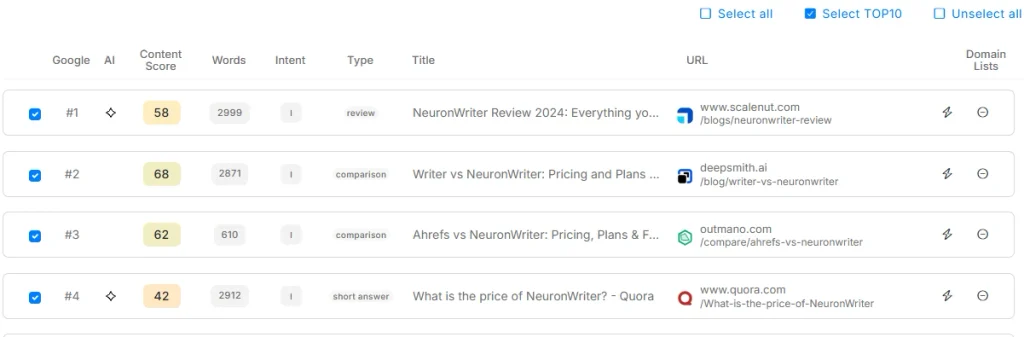
A reader searching for a review wants to know whether the software is useful, where it falls short, and for whom it makes sense. Someone searching for pricing may be trying to understand subscription tiers, annual billing, limits, or the distinction between standard plans and lifetime offers.
A pricing page can therefore be a useful comparator for a pricing-specific guide but a poor guide to the structure of a detailed product review. Conversely, a review may discuss prices without resolving a precise billing question.
If you analyze both queries for one article, decide which is primary. In our published NEURONwriter review, buying evaluation is the main job; pricing supports that decision. A new article about competitor selection should not reproduce its pricing table or commercial verdict.
This is also the practical meaning of topical SEO: related pages can serve different stages of a reader’s journey, provided each page has a distinct purpose.
Step 5: Update the Selection Without Starting Over
NEURONwriter’s official FAQ explains that the editor provides a route through Select Competitors and Custom Selection to revisit the comparison set. It also recommends selecting a set of relevant competitors rather than working from a single page. The exact interface wording may change, so check the live editor when following along.
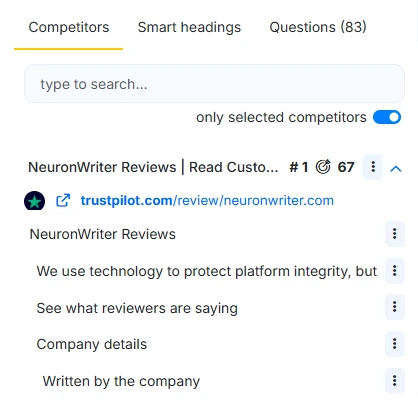
If the first set is mixed, you do not need to keep an unsuitable page just to preserve its ranking position. Recheck the intent statement, select relevant comparators, and review the resulting suggestions with editorial judgment.
Use these corrections when necessary:
- Wrong intent: replace a shopping/deal page when your planned content is a step-by-step tutorial.
- Wrong audience: avoid relying on enterprise documentation for a beginner-focused article unless the underlying instructions apply.
- Duplicate structure: diversify relevant models instead of choosing several near-identical articles just to fill a quota.
- Missing factual source: keep an official document as a reference even if you do not select it as an editorial comparison.
NEURONwriter also documents an option for adding custom URLs under advanced query settings. That can be useful when a particularly relevant reference is missing from the default results, but adding a URL does not make its contents authoritative.
Step 6: Turn SERP Research Into an Original Content Brief
Competitor selection should lead to decisions—not a patchwork of other people’s headings.
Create a brief with these components:
Reader task: What should the visitor be able to do after reading?
Essential questions: What questions appear repeatedly across the relevant pages, and which questions remain unanswered?
Verified sources: Which product settings, technical steps, or prices need checking against official documentation?
Original contribution: What can you show, explain, or evaluate that a generic competitor summary cannot?
Scope boundary: Which nearby intents belong in separate pages? For this guide, detailed pricing and the full NEURONwriter buying verdict belong in our existing review.
Internal-link plan: Where would a reader benefit from moving to another page? A tutorial reader evaluating whether to buy the software can use our published NEURONwriter review for plans, limitations, and buying guidance.
Evidence boundary: Label screenshots of a default competitor list as default results. Do not describe them as proof of the final selection if that state was not captured.
The strongest brief is not necessarily the one with the most suggested terms. It is the one that answers the reader’s task clearly and adds something credible.
How Competitor Selection Fits Into Topic SEO
Topic SEO is broader than one keyword or one optimization score. For a digital publishing site, it means covering related reader needs with pages that have distinct jobs, and linking those pages when the relationship helps navigation and understanding.
Our SEO & AI Writing Tools cluster currently has a commercial NEURONwriter review. A competitor-selection tutorial would support it by answering a practical question that a review only introduces. The reader path is natural: learn the method here, then use the review if they need to assess price, fit, and limitations.
This does not require forcing links from unrelated hosting articles or creating multiple thin pages for every NEURONwriter feature. It requires clear topic boundaries, strong answers, and selective contextual links.
For planning purposes, think in four layers:
- Understand: What is a SERP competitor, and why does intent matter? This guide introduces the concepts.
- Use: How do I choose relevant pages and adjust the set? This guide provides the workflow.
- Evaluate: Is NEURONwriter right for my publishing needs? The existing review answers this.
- Decide: Which plan and limitations matter? The existing review covers buying considerations.
A cluster is not automatically an authority simply because it contains more pages. Each supporting article must answer a distinct, worthwhile question.
Common Mistakes to Avoid
Accepting the first ten results automatically
A default selection is convenient, not an editorial verdict. Review whether each page addresses your intent before using its content structure to shape your brief.
Using Content Score as a ranking prediction
A Content Score can highlight possible gaps relative to the analyzed pages. It cannot certify that facts are accurate, that the writing is original, or that Google will rank the article. Our earlier review-editing records include a score moving from 52 to 58 inside the editor; that is an editing observation, not evidence of a search-ranking improvement.
Copying competitor headings
Competitor structures can reveal recurring topics, but reproducing an outline section by section rarely creates a useful reason for readers to choose your page. Build your own structure around the reader’s problem and verify your claims.
Mixing several search intents without a primary purpose
A tutorial can mention pricing and a review can include setup guidance. But if every section chases a different intent, readers may leave without a satisfying answer to their original question.
Treating forums, vendors, or AI outputs as independent proof
A vendor is an essential source for specifications, and community discussions can show real concerns. Neither should automatically establish comparative performance or factual accuracy. Verify important claims against primary documents and clearly describe any first-hand work.
Final Competitor-Selection Checklist
Before you optimize a draft, confirm that you can answer these questions:
- Can I explain the searcher’s task in one sentence?
- Are my main comparison pages written for a similar audience and intent?
- Have I separated factual reference pages from structural comparators?
- Have I excluded genuinely off-intent or redundant pages?
- Have I checked important product claims using primary sources?
- Does the brief identify an original contribution, rather than copy an outline?
- Are my screenshots and workflow statements supported by what was actually saved?
- Does this page have a distinct purpose within the site’s topic cluster?
If several answers are no, reconsider the comparator set before spending time optimizing wording or chasing a higher score.
FAQ
Should I select every top-ranking competitor in NEURONwriter?
No. Review the results against your planned article’s intent. A top-ranking page may serve a different task, such as buying a subscription rather than learning a workflow.
How many competitors should I use?
Use a useful set rather than a fixed quota. NEURONwriter’s official help recommends selecting multiple competitor URLs and provides guidance on revisiting the set. The appropriate mix depends on relevance and the available results.
Can I change the competitor selection after starting?
NEURONwriter documents a Custom Selection option within the editor’s competitor-selection controls. The interface may change, so follow the current official instructions.
Can I use pages that are not in the default results?
The product documentation describes custom URLs in advanced query settings. Add only pages that genuinely contribute to the analysis, and verify them independently.
Will better competitor selection improve my Google rankings?
It may improve the relevance of your research and editorial decisions, but no tool selection guarantees rankings. Google’s guidance emphasizes original, helpful, reliable content and a satisfying page experience rather than third-party optimization scores.
The Bottom Line
The hardest part of competitor analysis is not clicking checkboxes. It is deciding which pages answer the same question your reader has—and understanding what the remaining pages can contribute without distorting your article.
Start with intent, compare relevant page types, keep verified sources separate, and use NEURONwriter’s suggestions as editorial inputs rather than instructions. If you are still deciding whether the software suits your budget and workflow, read our NEURONwriter Review 2026 before choosing a plan.
Sources and Method
- NEURONwriter: How to start with New Query
- NEURONwriter: How to update competitor selection
- NEURONwriter: Add custom competitor URLs
- NEURONwriter: Optimization workflow
- Google Search Central: People-first content
Editorial method: The worked example uses stored TopDigitalProducts.com Q1 and Q2 research records alongside current official product guidance. Screenshots of initial results were distinguished from unverified final checkbox selections. No rankings, sales, or software test results were invented.