NEURONwriter Content Score Without Keyword Stuffing
A higher NEURONwriter Content Score can help you identify gaps in your article, but it does not automatically mean you have created better content.
If you treat every suggested term as a requirement, you may end up adding repetition, irrelevant information, or awkward headings that make your article harder to read.
A more reliable approach to content optimization is to use the score as a starting point for editorial review. Identify meaningful gaps, verify the information you plan to add, and ignore suggestions that do not serve your reader.
This guide explains how to use the NEURONwriter content editor, evaluate term suggestions, review Optimization Balance, and improve your writing without keyword stuffing.
Quick Answer: How Should You Use the Score?
Use NEURONwriter Content Score as a diagnostic tool for identifying potential improvements, not as a number you must maximize before publishing.
The goal of SEO content optimization is to produce a useful article that answers the reader’s question clearly and accurately.
Follow this simple workflow:
- Identify the reader’s search intent.
- Select competitors that address a similar topic and audience.
- Review suggested terms for genuine content gaps.
- Decide which suggestions to use, verify, or ignore.
- Improve the content structure, accuracy, and readability.
- Stop editing when additional changes no longer improve the article.
A useful recommendation should help you explain something better. It should not force you to write an unnecessary sentence just to satisfy a keyword count.
What Does NEURONwriter Content Score Measure?
NEURONwriter uses semantic recommendations to help publishers analyze and optimize content. Its Content Score provides a numerical assessment based on recommendations associated with the selected competitor pages.
The content editor can highlight suggested terms for the article body and headings. Incorporating relevant terms may improve the score, depending on how they are used and the analysis behind the recommendations.
Understanding term suggestions and coverage
NEURONwriter uses natural language processing (NLP) recommendations to surface words, phrases, and concepts associated with a topic.
These suggestions can help you discover related subjects that deserve attention in your article.
For example, a tutorial about website migration might benefit from explaining backups, DNS settings, and redirects. These concepts can make the guide more complete because they address important parts of the reader’s task.
However, not every suggested term represents a genuine information gap.
If a competitor discusses a different product, audience, or search intent, its terminology may not belong in your article.
What the score cannot measure
A numerical score cannot independently establish whether:
- Your factual claims are accurate.
- Your recommendations are appropriate for the reader.
- Your examples come from genuine experience.
- Your article offers something useful beyond existing search results.
- Your content will achieve a particular Google ranking.
Content Score is also different from NEURONwriter’s separate AI-related metrics. Each indicator should be interpreted according to its own purpose.
Treat the score as one part of your editorial workflow rather than a replacement for human judgment.
Before You Optimize Content, Check Search Intent
Before editing your article, complete this sentence:
“This article helps a specific reader accomplish a specific task.”
For this guide, the task is straightforward: help a publisher understand the NEURONwriter score and make better editorial decisions without keyword stuffing.
A reader searching for a complete product review has a different objective. They may want to compare pricing, features, subscriptions, and alternatives.
Both articles can discuss the same SEO tool, but they should not have the same content structure.
Why competitor selection matters
The pages selected for analysis influence the recommendations you receive.
A search engine results page (SERP) may include tutorials, product pages, reviews, videos, and discussion forums. These different content types do not necessarily serve the same purpose.
A product page might emphasize advanced features and conversion. A tutorial might focus on instructions and practical examples.
When recommendations are derived from pages that serve different search intents, some suggested terms may be less relevant to your draft.
Our guide to choosing SERP competitors in NEURONwriter explains how to make this decision before beginning the optimization process.
Once your comparison set makes sense, you can move from keyword research to meaningful content improvements.
The Use / Verify / Ignore Framework
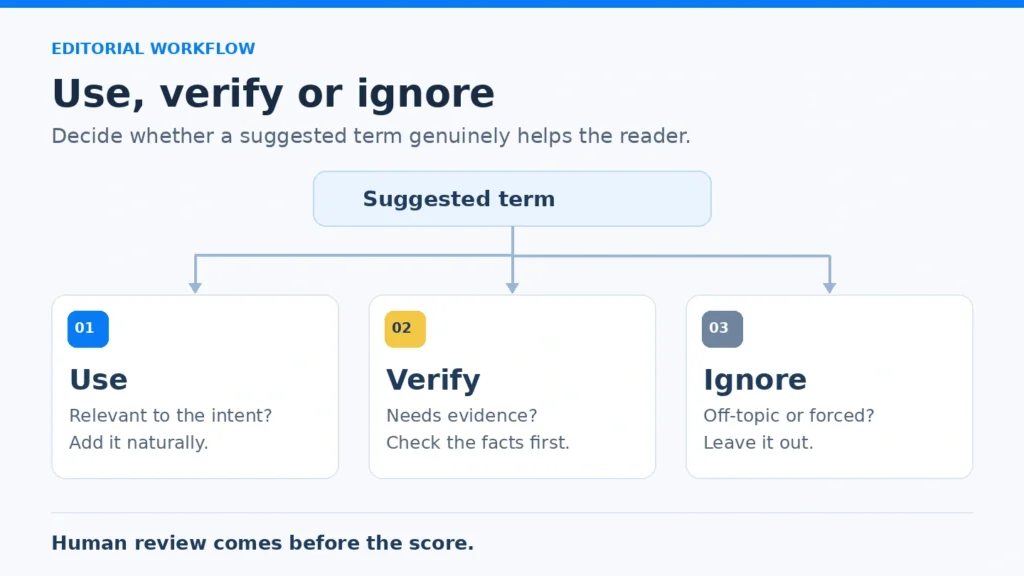
A practical way to work with NEURONwriter is to classify each suggested term into one of three categories: Use, Verify, or Ignore.
This framework helps you separate automated SEO recommendations from editorial decisions.
During our research for this guide, NEURONwriter suggested the following terms:
| Suggested term | Decision | Editorial reason |
|---|---|---|
| Content score | Use | It directly names the feature this tutorial explains. |
| Keyword density | Verify | It is relevant, but the explanation must not imply that one percentage is ideal for every article. |
| AI visibility platform | Ignore | It does not help the reader understand the specific optimization process covered here. |
These examples illustrate how we evaluated actual research recommendations. They are not evidence that including or excluding a particular term produces a measurable ranking improvement.
Use relevant terms naturally
Use a suggested term when it helps answer the reader’s question.
For example, suppose you are explaining how to choose pages for content analysis but have not mentioned search intent.
Adding that concept can clarify why a product landing page and a detailed tutorial may not be suitable alternatives for the same article.
You do not need to repeat the phrase in every paragraph. Introduce it where it provides useful context, explain its meaning, and continue with the article.
The goal is to create better content, not simply to increase the number of recognized terms.
Verify meaning and factual accuracy
Some suggestions are relevant but require additional research before you include them.
For example, a term such as WordPress integration may be useful in a NEURONwriter buying guide. However, the availability of an integration can depend on the subscription or offer being discussed.
Before publishing a claim about such a feature, consult the current official documentation.
The same principle applies to statistics, prices, technical instructions, and product limitations. A suggested term does not make an accompanying claim true.
Also verify whether the proposed wording actually improves your sentence. If a rewrite is less precise or harder to understand, keep the clearer version.
Ignore irrelevant or forced suggestions
Ignore a term when it does not contribute to the reader’s task.
A guide about Content Score does not need to explain every AI writing feature, subscription allowance, or content generation template.
Those subjects may be relevant to a general product review, but introducing them here could distract from the tutorial.
Ignoring irrelevant recommendations is a legitimate content optimization decision.
It is not a failure to use the software correctly.
Keyword Density vs Keyword Stuffing
Keyword density describes how frequently a word or phrase appears relative to the length of a text.
It can help an editor notice unusual repetition, but there is no universal density percentage that guarantees high-quality content or better search engine rankings.
Keyword stuffing is different.
Google describes keyword stuffing as filling a page with keywords or numbers in an attempt to manipulate search rankings. Repeated phrases and unnatural lists that provide little value can be examples of this practice.
Consider this deliberately artificial example:
“Use a content score tool to improve your content score because a better content score makes content score optimization easier.”
The phrase appears several times, but the sentence gives the reader little useful information.
A clearer version would be:
“Use the score to identify possible gaps, then decide which recommendations improve the article.”
This version communicates the same general idea without unnecessary repetition.
Is repeating a target keyword always bad?
No.
An article about a specific software feature will naturally use the feature’s name more than once.
For example, this tutorial uses the phrase Content Score repeatedly because it is the subject of the guide.
The important question is whether each occurrence adds clarity or merely attempts to satisfy a frequency recommendation.
You can review keyword usage by reading a paragraph aloud. If the same phrase appears repeatedly without contributing additional meaning, rewrite the passage.
If replacing a precise technical term makes the explanation less accurate, keep the correct terminology.
Good content writing balances topical relevance with natural language and reader understanding.
A Practical Example From Our NEURONwriter Research
Our earlier editorial work on the NEURONwriter review included two documented observations inside the editor: an initial score of 52 and a later score of 58.
These historical records provide useful context, but they have an important limitation.
The final article body saved inside the editor was not conclusively matched to the local patch file. We cannot determine which specific edits caused the difference, and the observations do not establish an improvement in Google rankings.
What we can examine is the editorial reasoning recorded during the process.
Making a heading more specific
One proposed change involved the following heading:
Before:
Key Features That Matter
Proposed revision:
NEURONwriter Key Features
The revised heading identifies the product directly and gives readers a clearer indication of what the section covers.
The phrase is relevant to a product review, so the change has an editorial justification beyond its possible effect on the score.
Clarifying a technical explanation
Another proposed edit considered changing this sentence:
Before:
It analyzes search results around a query and presents information intended to help a writer understand competitors, plan topics and improve a draft.
Proposed revision:
It analyzes search results for a target keyword or query and presents information intended to help a writer understand competitors, plan topics and improve a draft.
The revised wording introduces a relevant concept that can help beginners understand how content analysis starts.
However, we cannot attribute the historical score increase to this particular change.
Rejecting unnecessary repetition
Our archived research also included recommendations to repeat product names and introduce phrases that did not naturally fit the article.
Instead of forcing these terms into the draft, we treated them as suggestions to evaluate.
This is the practical lesson: use optimization recommendations to identify possible improvements, but make each change for a clear editorial reason.
The score is feedback from the tool. The finished article is your responsibility.
How to Review Optimization Balance
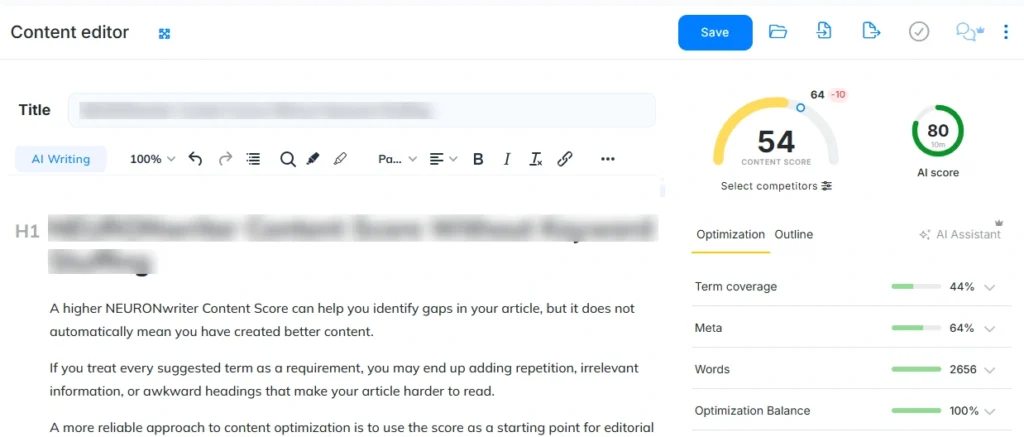
NEURONwriter’s Optimization Balance helps you monitor suggested term usage and identify areas that may need further review.
When optimizing existing content, this can be especially useful for noticing unnecessary repetition or deciding whether a missing term deserves attention.
However, a warning inside the tool is not automatic proof that your article violates Google’s spam policies.
A term might appear frequently because it is the correct name of the feature you are explaining. Alternatively, it may appear frequently because several paragraphs repeat the same idea.
A five-step review process
When you encounter a flagged term in the content editor:
- Read the surrounding sentences. Determine whether each occurrence serves a distinct purpose.
- Check topical relevance. Ask whether the concept helps answer the reader’s question.
- Remove unnecessary repetition. Combine similar sentences where possible.
- Review headings separately. Make sure each heading describes its section clearly.
- Read the revised passage. Choose the version that offers the best balance of accuracy and readability.
For example, a section about SEO optimization may naturally use the word “optimize” more than once.
You do not need to replace every occurrence with an awkward synonym. Instead, remove repetition that adds no new information.
Review the article as a whole
Term Coverage and Optimization Balance can help you identify areas for improvement, but they should not be considered in isolation.
Look at the entire content creation process:
- Does the introduction answer the reader’s main question?
- Does the article explain important concepts in a logical order?
- Are factual claims supported by trustworthy sources?
- Are examples clear and useful?
- Does the article provide relevant content without unnecessary sections?
An article that performs well in these areas may deserve to be published even when some software recommendations remain unused.
When Should You Stop Optimizing?
You can stop when the article answers the intended question, important claims have been verified, and further changes would not improve the reader’s experience.
A useful stopping checklist includes:
- The search intent remains clear.
- Important concepts have been explained.
- The content structure is easy to follow.
- Technical claims have been checked.
- Repeated phrases have an editorial purpose.
- Internal links help readers find related information.
- Remaining suggested terms are either unnecessary or outside the article’s scope.
A higher score may still be possible.
But if increasing it requires irrelevant sections, repeated keywords, or less natural language, the additional changes may not be worthwhile.
Common Content Score Mistakes
Chasing a universal score
There is no single score that proves every article is ready to publish.
Different competitor sets, topics, and content types can produce different recommendations.
Evaluate the result in context rather than assuming every article must reach the same number.
Adding sections just to include keywords
A new section should solve a reader problem.
If a suggested term introduces a completely different subject, consider whether it belongs in another article instead.
Forcing unrelated sections into a tutorial can weaken its focus.
Copying the competitor’s content structure
Competitor research can reveal useful topics and common questions, but it should not replace your own editorial planning.
Use the research to identify gaps and develop a structure that serves your audience.
Removing every repeated phrase
Repetition can be necessary when explaining a product, process, or technical concept.
Replace or remove wording only when the revised version remains accurate and reads more naturally.
Publishing AI-generated content without review
AI writing tools can help develop ideas or draft explanations, but their output still requires human review.
Check facts, examples, and recommendations before publishing. Fluent writing is not proof of factual accuracy.
Frequently Asked Questions
What is a good NEURONwriter Content Score?
There is no universally ideal number.
Assess the score alongside the relevance of your competitor set, the completeness of the article, and the quality of the information you provide.
Use it to guide editorial improvements rather than establish a fixed publishing threshold.
Does a higher Content Score guarantee better Google rankings?
No. NEURONwriter calculates its own optimization score, while Google uses its own ranking systems.
A higher tool score does not independently establish that an article will rank higher in search results.
Should I use every suggested term?
No.
Use recommendations that contribute to the article’s purpose. Verify claims that need evidence, and ignore suggestions that create repetition, introduce irrelevant topics, or weaken clarity.
Can I improve an article without making it longer?
Yes.
You may be able to clarify a sentence, improve a heading, remove repetition, or reorganize an explanation without increasing the word count.
Add new content when it answers a genuine reader question.
Can I use NEURONwriter for existing content?
Yes. You can apply the same review process to an existing draft or article.
Check its purpose, evaluate suggested terms, and make targeted improvements without rewriting useful sections unnecessarily.
If you are considering the tool for your publishing workflow, our NEURONwriter review provides additional information about its features, subscription options, and limitations.
Final Takeaway
NEURONwriter can help publishers optimize content for search engines while keeping editorial decisions in human hands.
The most useful approach is simple:
- Start with the reader’s search intent.
- Select relevant competitors.
- Use helpful recommendations naturally.
- Verify information before adding it.
- Ignore terms that do not improve the article.
- Review readability and Optimization Balance before publishing.
Content optimization works best when every change has a reason beyond increasing a score.
Use the recommendations to discover opportunities, then publish the article that best serves your reader.
Sources and Method
This guide combines NEURONwriter’s official documentation, Google Search Central guidance, and TopDigitalProducts.com’s editorial research records.
Our historical example refers to an earlier NEURONwriter review project. The recorded scores of 52 and 58 are observations from that workflow, not evidence of a controlled experiment or a search-ranking improvement.